
Nachdem wir nun ein ganzes Monat in Japan verbracht haben und uns an der Kulinarik hier laben durften, ist es an der Zeit die Highlights auszuarbeiten. Wir probierten uns beinahe durch das komplette kulinarische Repertoire, soweit es unsere Brieftasche zuließ. Angefangen mit Ramen und Sushi über Shabu Shabu, Yakiniku und Tonkatsu zu Okonomiyaki und Takoyaki Street Food. Extra angeführt sollte vermutlich auch das Shojin Ryori Mahl werden, welches wir in Koyasan in einem Buddhist Tempel genießen durften.
Beginnen wir mit den beiden konstanten Highlights unserer kulinarischen Reise, Ramen und Sushi.
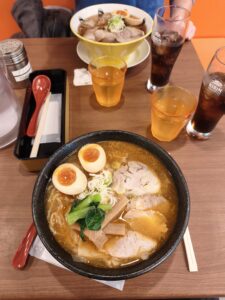
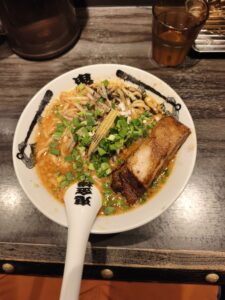
Ramen war unser go-to Essen wenn wir uns nicht sicher waren wo wir hingehen. Keine zwei Ramen schmeckten gleich, aber alle Ramen schmeckten vorzüglich. Ganz gleich ob mit einem soja-basierten oder fleisch-basierten Fond, mit verschiedenstem Gemüse, mit Rindfleisch oder Schweinefleisch, oder gar mit Faschiertem (Tantanmen genannt) – jeder Ramen war vorzüglich, der Fond war immer reichhaltig an Salz und Umami und konnte oft in unterschiedlichen Schärfegraden bestellt werden. Das Fleisch zart und das Gemüse frisch und knackig und die selbst gemachten Nudeln einfach göttlich. Hätten wir nicht den Plan gehabt so viel wie möglich hier in Japan zu probieren, dann hätten wir uns womöglich das ganze Monat nur von Ramen ernährt. Wäre auch um einiges leichter fürs Portemonnaie gewesen.
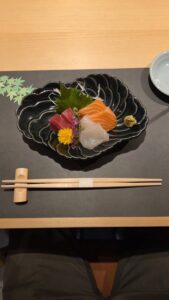
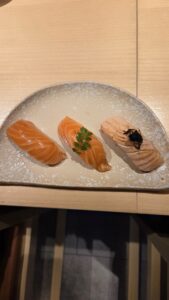
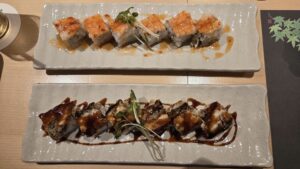
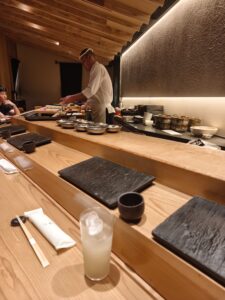
Ähnlich ging es uns mit Sushi. Man konnte sehen, dass Sushi aus Japan stammt. Jedes Sushi-Restaurant baute auf die höchste Qualität und den frischesten Fisch, jedes Sushi von einem Meister in der offenen Küche zubereitet, während man selbst am Tresen sitzt und dem ganzen Schauspiel live beiwohnen kann. Wir haben in Japan beide eine Vorliebe für Nigiri entwickelt, da der Fisch und Reis selbst so intensiv und reichhaltig an Geschmack war, dass neben qualitativ hochwertigem Wasabi nichts weiter notwendig war, um den Happen zu perfektionieren. Zum Thema Sushi ist die Qualität der einzelnen Produkte wirklich das A und O des Gerichts und das Zubereiten jedes einzelnen Sushi eine Kunst.
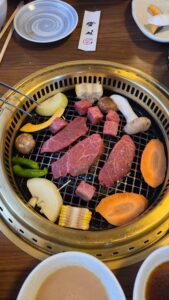
Nun zu den Gerichten in denen uns rohes Fleisch serviert wurde, welches wir selbst am Tisch grillen durften. Wir hatten in Takayama unser erstes und einziges Erlebnis mit Shabu Shabu und Yakiniku und es war hervorragend, aber auch herausfordernd. Wir bestellten nach Lust und Laune was uns von den Bildern gerade ins Auge sprang und wurden dann mit Tellern von rohem Fleisch und Gemüse, sowie mit einer Kochplatte mit einem Topf voll Wasser überhäuft und der eingebaute Tischgrill wurde für uns aktiviert. Der Yakiniku Teil, also das Grillen von Fleisch und Gemüse am Tisch war uns klar und geläufig, jedoch der Shabu Shabu Teil hat uns zu dem Zeitpunkt komplett überfordert, da wir vollkommen ahnungslos waren. Gottseidank gab es in der Speisekarte eine Anleitung der wir folgen konnten.
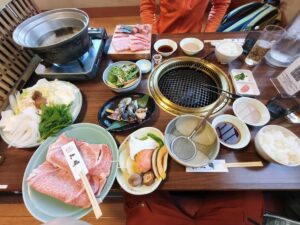
Shabu Shabu ist ein „Brühfondue“ in dem zuerst das rohe Gemüse im Wasser blanchiert bzw gekocht wird, und dem Fond etwas Geschmack verleiht. Anschließend wird das hauchdünne Fleisch für wenige Sekunden in dem kochendem Fond gegart und dann gemeinsam mit dem Gemüse konsumiert. Hierfür gab es eine sesambasierte Sauce für das Fleisch und eine Ponzu-Sauce (basierend auf Soya und Zitrus) für das Gemüse. Nachdem das gesamte Fleisch und ein Teil des Gemüses gegessen wurden, fügt man abschließend die Udon oder Glasnudeln hinzu und genießt die nun reichhaltige Brühe in Form von Ramen.
Abschließend in dieser Kategorie noch das Tonkatsu beziehungsweise in unserem Fall Gyukatsu (Wagyu Rind anstelle von Schweinefleisch). Uns als Österreicher das Schweineschnitzel grundsätzlich sehr bekannt und ich selbst kannte es auch aus meiner Zeit in der japanisch-peruanischen Küche in Dänemark aber nicht auf diese Art und Weise.
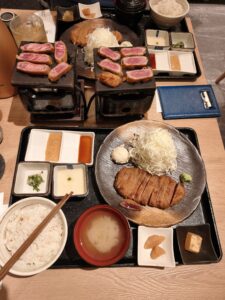
Wir erhielten unser Gyukatsu in Form eines Sets mit diversen Beilagen wie Salat und Reis, einer Miso-Suppe, sowie 2 verschiedenen Saucen und Wasabi. Das Schnitzel war nur kurz in der Panade anfritiert, sodass das Fleisch innen noch vollkommen roh war und dann in Streifen geschnitten serviert. Wir selbsten durften anschließend jedes Fleischstück bis zum gewünschten Garpunkt auf einer Grillplatte vollenden und genießen.
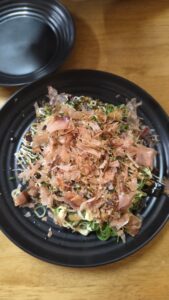
Abschließend noch die beiden typischen Streetfood-Gerichte, die beinahe überall in Japan gefunden werden können. Okonomiyaki ist eine Art Kohl-Pfannkuchen aus Mehl, Ei, Wasser und zerkleinertem Kohl, der auf einer heißen Platte zubereitet wird – oftmals kann man Käse, Speck oder andere Zutaten hinzufügen und das Ganze wird dann mit Seegrasflocken, Soya oder Ponzu und Katsuobushi (getrockneten geräucherten Thunfischflocken) vollendet und serviert.
Takoyaki im Vergleich ist ein wenig simpler gestaltet. Es handelt sich hier um einen Teig in Kugelform gefüllt mit Oktopusstücken, eingelegtem Ingwer und Frühlingszwiebel plus ein paar Gewürzen und oftmals mit einer Sauce vollendet. Ganz spannend hier ist den Profis bei der Zubereitung zuzuschauen. Die Zutaten werden jeweils in geölte kleine Runde Grillformen platziert und nach kurzer Zeit mit Stäbchen in einem äußerst gekonnten Manöver über mehrere Bewegungen sowohl gedreht als auch der Teig ineinandergefaltet, ein sehr spannender Anblick und vom Tempo her kaum mitzuverfolgen.
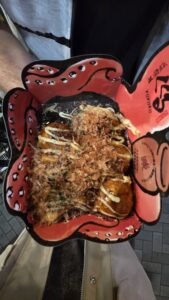
Takoyaki hat uns beiden persönlich weniger geschmeckt, da der Teig innen sehr weich ist und uns die Konsistenz nicht wirklich zugesagt hat.
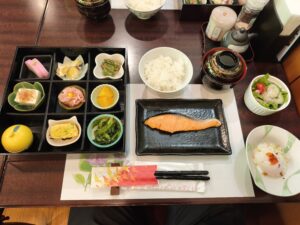
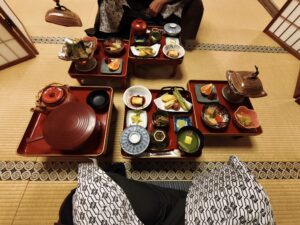
Einen besonderen Platz hat für uns auch das einzigartige Abendessen und Frühstück, das wir in unserer Tempelunterkunft in Koyasan erhielten, zubereitet von einem 83 jährigen buddhistischen Meisterkoch, sowie das japanische Frühstück, das wir unserem Ryokan in Hakone genießen durften.
Diese Mahlzeiten bestanden immer aus einem Set verschiedenster kleiner Portionen, jede einzelne auf verschiedene Art und Weise zubereitet und teilweise mariniert und das Ganze mit einer Portion Reis und Matcha Grüntee serviert.
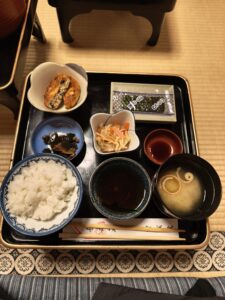
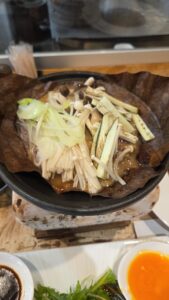
Das Besondere in Koyasan war das wirklich spannende komplett vegane Abendmahl das uns serviert wurde und das dazugehörige Highlight, verschiedenstes Gemüse und Pilze die in ein Bananenblatt gelegt und in einer Miso Sauce über einer Flamme gegart wurden.
Eine abschließende Erwähnung geht noch an zwei typisch japanische Gerichte aus, Tempura und Mochi.
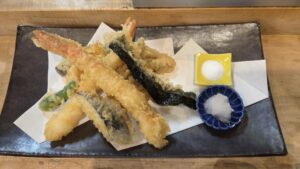
Tempura ist eine simple Panade aus Tempura-Mehl und Wasser und bildet eine sehr luftig, teigige Panade. Es war für uns häufig in mit verschiedenem Gemüse und Shrimps anzufinden.
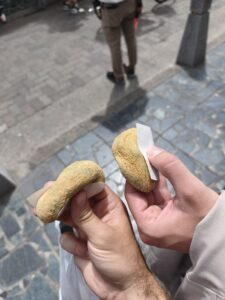
Mochi auf der anderen Hand ist ein Dessert aus klebrigem Mochigome-Reisteig gefüllt mit roter Bohnenpaste und ein äußerst beliebtes, alljährliches Gericht in ganz Japan. Mochi darf in keinem Japanurlaub fehlen und sollte definitiv zumindest einmal probiert werden. Der Geschmack und die Textur des Desserts ist einzigartig, wobei es uns am Besten frisch gemacht und noch leicht warm geschmeckt hat.
Neben unseren ganzen Erlebnissen hier in Japan war auch die kulinarische Erkundung für uns ein alleiniges Abenteuer das auf keinen Fall fehlen durfte.
English:
Now that we’ve spent a whole month in Japan and had the chance to indulge in the local cuisine, it’s time to round up the highlights. We sampled almost the entire culinary repertoire, as far as our wallets would allow. Starting with ramen and sushi, through shabu-shabu, yakiniku and tonkatsu, to okonomiyaki and takoyaki street food. The Shojin Ryori meal we enjoyed at a Buddhist temple in Koyasan probably deserves a special mention as well.
Let’s start with the two constant highlights of our culinary journey: ramen and sushi.
Ramen was our go-to meal whenever we weren’t sure where to go. No two bowls of ramen tasted the same, but they all tasted delicious. Whether with a soy-based or meat-based broth, with a wide variety of vegetables, with beef or pork, or even with minced meat (known as tantanmen) – every bowl of ramen was exquisite; the broth was always rich in salt and umami and could often be ordered with varying degrees of spiciness. The meat was tender, the vegetables fresh and crisp, and the homemade noodles simply divine. Had we not planned to try as much as possible here in Japan, we might well have lived on ramen for the whole month. It would also have been a fair bit easier on the wallet.
We felt the same way about sushi. You could tell that sushi originated in Japan. Every sushi restaurant prided itself on the highest quality and the freshest fish, with every piece of sushi prepared by a master in the open kitchen, whilst you sat at the counter and could watch the whole spectacle unfold live. We both developed a taste for nigiri in Japan, as the fish and rice themselves were so intense and rich in flavour that, apart from high-quality wasabi, nothing else was needed to perfect the bite. When it comes to sushi, the quality of the individual ingredients really is the be-all and end-all of the dish, and the preparation of each piece of sushi is an art form here.
Now to the dishes where we were served raw meat, which we grilled ourselves at the table. In Takayama, we had our first and only experience with shabu-shabu and yakiniku, and it was excellent, but also challenging. We ordered whatever took our fancy from the pictures that caught our eye and were then presented with plates of raw meat and vegetables, as well as a hotplate with a pot full of water, and the built-in table grill was switched on for us. The Yakiniku part – grilling meat and vegetables at the table – was clear and familiar to us, but the Shabu Shabu part completely overwhelmed us at the time, as we were completely clueless. Thankfully, there were instructions on the menu that we could follow.
Shabu Shabu is a ‘broth fondue’ in which the raw vegetables are first blanched or cooked in the water, adding flavour to the broth. The paper-thin slices of meat are then cooked in the boiling broth for a few seconds and eaten together with the vegetables. You basically just hold the meat in your chopsticks and swish it around in the pot until it’s done. For this, there was a sesame-based sauce for the meat and a ponzu sauce (made from soya and citrus) for the vegetables. Once all the meat and some of the vegetables have been eaten, you add the udon or glass noodles and enjoy the now rich broth in the form of ramen.
The final dish in this category is the tonkatsu, or in our case, gyukatsu (Wagyu beef instead of pork). As Austrians, we are generally very familiar with pork cutlets, and I myself knew the dish from my time working in Japanese-Peruvian cuisine in Denmark, but not in this particular way.
We were served our gyukatsu as a set with various side dishes such as salad and rice, a miso soup, as well as two different sauces and wasabi. The cutlet was only briefly fried in the batter, so that the meat was still completely raw on the inside, and then served cut into strips. We were then allowed to finish cooking each piece of meat to our desired point of the meat on a table grill and enjoy it.
Finally, the two typical street food dishes that can be found almost everywhere in Japan. Okonomiyaki is a kind of cabbage pancake made from flour, egg, water and shredded cabbage, cooked on a hot grill – you can often add cheese, bacon or other ingredients, and the whole thing is then finished off with seaweed flakes, soy sauce or ponzu and katsuobushi (dried, smoked bonito flakes) before being served.
Takoyaki, by comparison, is a little simpler in design. It consists of a ball-shaped batter filled with pieces of octopus, pickled ginger and spring onions, plus a few spices, and is often finished with a sauce. It’s really fascinating to watch the professionals prepare it. The ingredients are placed into small, oiled round grill moulds and, after a short while, using chopsticks in an extremely skilful manoeuvre involving several movements, they are both turned and the batter folded inwards – a very exciting sight and almost impossible to follow in terms of speed.
Personally, neither of us enjoyed the takoyaki as much, as the batter is very soft on the inside and we didn’t really like the texture.
The unique dinner and breakfast we were served at our temple accommodation in Koyasan, prepared by an 83-year-old Buddhist master chef, also hold a special place in our hearts, as does the Japanese breakfast we were able to enjoy at our ryokan in Hakone.
These meals always consisted of a selection of various small portions, each prepared in a different way and some marinated, all served with a portion of rice and matcha green tea.
What made Koyasan special was the truly exciting, completely vegan evening meal we were served, and the highlight of that – a variety of vegetables and mushrooms placed in a banana leaf and cooked in a miso sauce over an open flame.
Our honorable mentions go to tempura and mochi, since these two are not allowed to miss when talking about food in Japan.
Tempura is a simple batter made of tempura flour and water, that creates a fluffy shell around the vegetables or shrimps that it is usually combined with. It can be found in almost every restaurant in one way or another.
Mochi on the other hand, is a dessert made of mochigome-rice dough, filled with red bean paste. The finishing touches need to be done by 2 chefs, slapping and folding the dough in quick succession – a video that went viral before. Mochi has such a unique taste and texture that it has be to tried if one gets a chance, however, the best ones we had were freshly made and still warm when we got them.
Alongside all our experiences here in Japan, our culinary exploration was an adventure in its own right that we simply couldn’t have missed.