Natürlich darf die Kulinarik auf unserer Reise nicht fehlen. Wir haben es uns zur Aufgabe gemacht so viele Speisen wie möglich auszuprobieren, da es ein wichtiger Teil ist, um das Land, in diesem Fall Nepal, voll zu erleben. Ich werde zum Abschluss eines jeden Landes einen kurzen Eintrag über unser kulinarischen Abenteuer schreiben, indem ich nicht alle, aber die wichtigsten Gerichte kurz anführe und zusätzlich ein paar Bilder zur Verfügung stellen.
Die Küche in Nepal ist sehr stark von den direkten Nachbarländern beeinflusst. Beinahe jedes nepalesische Restaurant offeriert auch eine Variation von indischem Curry und chinesischem Chowmein. Parallel gibt es zumindest in den beiden Städten Kathmandu und Pokhara dutzende Restaurants, die sich spezifisch auf die Küche eines naheliegenden Landes spezialisiert haben.
Die nepalesische Küche:
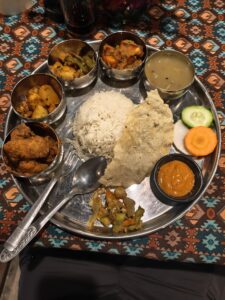
Lasst uns mit Dal Bhat, Thakali Khana Set und Thakali Khaja Set beginnen. Alle 3 sehr ähnlich, ein Gericht, dass aus Reis sowie einer Variation aus Fleischeintopf, Gemüsecurry und verschiedenem eingelegtem Gemüse besteht. Die ersten beiden inkludieren auch eine Linsensuppe.
Nun zu den Unterschieden der Drei.
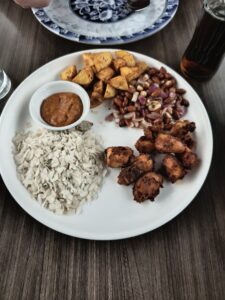
Thakali Khaja Set ist eigentlich nur als Snack gedacht, daher ohne Linsensuppe und mit „Chiura“ – Reis der gekocht, geplättet und getrocknet wird und dadurch eine festere, knusprigere Konsistenz erhält. Oftmals auch mit geröstetem Fleisch anstelle des Eintopfs. Hier sollte erwähnt sein, dass Chiura uns beide nicht überzeugt hat.
Das Thakali Khana Set ist eine Variation des Dal Bhat der Thakali Gemeinschaft aus der Mustang Region. Hier wird gerne mal Yak verwendet und Gewürze wie Jimbu und Timur, zwei Gewürze aus dem Himalaya Gebiet. Ersteres für Zwiebel- und Knoblauchnoten bekannt, während das Zweite eng mit dem Szechuan Pfeffer verwandt ist.
Nun zum Dal (=Linsensuppe) Bhat (=Reis) selbst. Es ist die Hauptspeise in Nepal und wird von den Einheimischen 2 Mal täglich, morgens und abends gegessen. Das Gericht trägt das Motto „Dal Bhat Power 24 Hour“, da es besonders nährstoffreich ist und damit optimal für Trekker und lange Wanderungen.
Insbesondere während unseres Treks konnten wir in jedem Guesthouse Dal Bhat finden und sind uns darin einig, dass wir dort unser bestes Dal Bhat verzehrt haben.
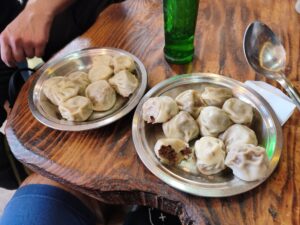
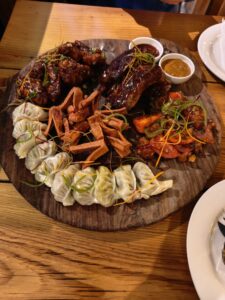
Ein weiteres großes Thema sind „Momo“ – nepalesische Teigtaschen gefüllt mit Huhn, Büffel oder Gemüse, die auf dutzende verschiedene Weisen zubereitet werden können. Unsere bevorzugte Variante war gedämpft, wobei wir manche Varianten nicht ausprobiert haben, weil wir nicht wussten worum es sich genau handelt und wir zu faul waren nachzufragen oder zu googeln. Mit gedämpften Momo liegt man niemals falsch.
Vermutlich die besten Momo haben wir gleich am ersten Tag in Kathmandu gegessen, eine Empfehlung eines Freundes, direkt am Kathmandu Durbar Square gelegen, das Narayandai Momo Lokal.
Sam, unser hervorragender privater Guide am zweiten Tag, hat uns die beiden Newari Desserts Yomari und Bara vorgestellt. Ersteres, eine süße Teigtasche aus Reismehl, häufig gefüllt mit einer Art karamellisiertem Zucker oder einer etwas herberen käsigeren Füllung. Zweiteres im Gegensatz dazu, ist ein traditioneller pikanter Pancake aus Linsen + einer Vielfalt an Gewürzen wie Ingwer, Knoblauch und Kurkuma. Es waren definitiv gut gemachte einzigartige Desserts, jedoch konnten beide nicht wirklich unseren Geschmack treffen.
Natürlich dürfen auch die beiden Getränke die Matthias’s Zeit hier in Nepal dominiert haben, nicht fehlen. Masala Tee, ein würziger Schwarztee mit Ingwer, Zimt, Nelke, Cardamom, schwarzem Pfeffer und einem mindestens 50%igen Anteil an Milch; und Bananen Lassi. Zugegebenermaßen, jegliche Form von Lassi, jedoch war Bananen Lassi die bevorzugte Form. Ein Kaltgetränk aus dem indischen Bereich, sehr stark in Nepal verbreitet, welches sich hauptsächlich aus Joghurt, Milch, einer Frucht (in dem Fall Banane) und einer Art von Süßungsmittel wie Honig, zusammensetzt. Ich selbst bin bei Joghurt ausgestiegen, also übernehme ich keine Verantwortung bei der Auflistung der anderen Zutaten und kann keine objektive Haltung dazu einnehmen.
Finalisierend noch 2 honorable Mentions:
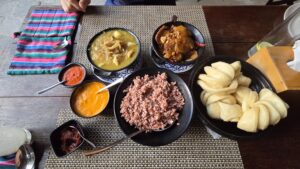
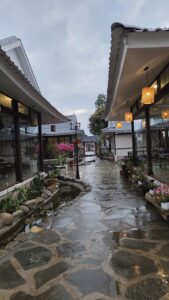
Eines der besten Restaurants in Kathmandu in Bezug auf Ambiente und großartigem Essen war für uns das Dechenling Garden Restaurant am Rand des Thamel Bezirks. Hier labten wir uns an bhutanischem Pak und tibetischen Aloo Phing Sha (Potato – Glass noodles – meat) gemeinsam mit rotem Reis und Ting Momo – ein gedämpftes tibetisches Brot.
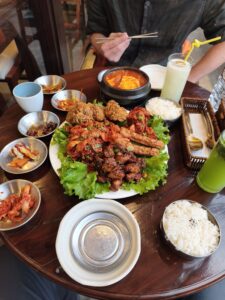
Einen ähnlichen Anwärter konnten wir auch in Pokhara antreffen. Das Hankook Sarang Korean Restaurant (hierbei ist nicht das gleichnamige Restaurant Nähe Phewa Lake gemeint) hat uns ähnlich, mit umwerfender Location umgarnt und uns kaum wieder losgelassen. Ein tolles koreanisches Restaurant mit aufmerksamen Personal und schnellem Service, wobei man erwähnen sollte, dass wir die einzigen Gäste waren, da es geregnet hat, und wir ausnahmsweise mal nicht aus Zucker waren. Wir haben uns eine große Platte mit verschiedensten Gerichten servieren lassen, bekamen ein paar koreanische Appetizer, sowie einen koreanischen grünen Tee und Wasser complementary und waren so voll und zufrieden, dass wir einen Teil mit ins Hotel nahmen und spät abends unter höchster Konzentration im Bett verspeisten um nichts anzukleckern.
English:
Of course, good food is an essential part of our trip. We’ve made it our mission to try as many dishes as possible, as this is key to fully experience the country – in this case, Nepal. At the end of our time in each country, I’ll write a short post about our culinary adventures, briefly listing not all but the most important and outstanding dishes and including a few photos.
Nepalese cuisine is heavily influenced by its immediate neighbours. Almost every Nepalese restaurant also offers a variation of Indian curry and Chinese chow mein. At the same time, at least in the two cities of Kathmandu and Pokhara, there are dozens of restaurants that specialise specifically in the cuisine of a neighbouring country.
Nepalese cuisine:
Let’s start with Dal Bhat, Thakali Khana Set and Thakali Khaja Set. All three are very similar: a dish consisting of rice and a combination of meat stew, vegetable curry and various pickled vegetables. The first two also include a lentil soup.
Now to the differences between the three.
The Thakali Khaja Set is actually intended merely as a snack, hence it contains no lentil soup and features ‘chiura’ or beaten rice – rice that is cooked, flattened and dried, giving it a firmer, crispier texture. It is often served with roasted meat instead of the stew. It should be noted here that neither of us was particularly fond of the chiura.
The Thakali Khana Set is a variation of Dal Bhat from the Thakali community in the Mustang region. Yak is often used here, along with spices such as Jimbu and Timur, two spices from the Himalayan region. The former is known for its onion and garlic notes, whilst the latter is closely related to Szechuan pepper.
Now to the Dal (=lentil soup) Bhat (=rice) itself. It is the staple dish in Nepal and is eaten by the locals twice a day, in the morning and in the evening. The dish goes by the motto ‘Dal Bhat Power 24 Hour’, as it is particularly nutrient-rich and therefore ideal for trekkers and long hikes.
During our trek in particular, we were able to find Dal Bhat in every guesthouse and agreed that we ate our best Dal Bhat there.
Another big topic is “momo” – Nepalese dumplings filled with chicken, buffalo or vegetables, which can be prepared in dozens of different ways. Our favourite version was steamed, though we didn’t try some varieties because we didn’t know exactly what they were and were too lazy to ask or google it. However, you can never go wrong with steamed momos.
We probably ate the best momos on our very first day in Kathmandu, a recommendation from a friend: the Narayandai Momo, located right on Kathmandu Durbar Square.
Sam, our excellent private guide on the second day, introduced us to two Newari desserts, yomari and bara. The former is a sweet dumpling made from rice flour, often filled with a kind of caramelised sugar or a slightly tangier, cheesier filling. The latter, by contrast, is a traditional savoury pancake made from lentils and a variety of spices such as ginger, garlic and turmeric. They were definitely well-made, unique desserts, though neither really suited our taste.
Of course, we mustn’t forget the two drinks that have dominated Matthias’s time here in Nepal: masala tea, a spicy black tea with ginger, cinnamon, cloves, cardamom, black pepper and at least 50% milk; and banana lassi. Admittedly, any form of lassi, but banana lassi was the preferred choice. A cold drink from the Indian region, very widespread in Nepal, consisting mainly of yoghurt, milk, a fruit (in this case banana) and some kind of sweetener such as honey. I myself stopped at the yoghurt, so I take no responsibility for listing the other ingredients and cannot adopt an objective stance on the matter.
Finally, two honourable mentions:
One of the best restaurants in Kathmandu in terms of atmosphere, with excellent food was, for us, the Dechenling Garden Restaurant on the edge of the Thamel district. Here we feasted on Bhutanese pak and Tibetan aloo phing sha (potato – glass noodles – meat), along with red rice and ting momo – a steamed Tibetan bread.
We also came across a similar contender in Pokhara. The Hankook Sarang Korean Restaurant (not to be confused with the restaurant of the same name near Phewa Lake) similarly charmed us with its stunning location and we could hardly tear ourselves away. A great Korean restaurant with attentive staff and speedy service, though it should be noted that we were the only guests, as it was raining and, for once, weren’t made of sugar. We were served a large platter of various dishes, received a few complimentary Korean appetisers, as well as complimentary Korean green tea and water, and were so full and satisfied that we took some of it back to the hotel and ate it in bed late at night with the utmost concentration so as not to make a mess of the bed sheets.